Pages

Showing posts with label Seasonal. Show all posts

Wednesday, 13 June 2012

Summery chicken stew


The Boy and I have spent a glorious week touring the country to see friends and family. Naturally, our trips tend to revolve around food. We’ve barbecued near Bristol, sipped cider on the Cam (bringing a little bit of Somerset to Cambridge!) and noshed on marshmallows on a narrow boat.

Summer signals a flurry of activity for most people – time to make hay while the sun shines. If it’s raining – or if you’re busy dashing about doing a myriad of things simultaneously – you might like to come in after a long day to a bowl of stew.

This creamy chicken stew is light and fresh enough to suit a warm (if damp) summers day. As with all of my recipes, it’s easy and rather forgiving; you can leave it bubbling away on the stove (or in the oven – a similar amount of time at 180C should do the trick) while you go about your business. And, as long as you take care to ensure that it doesn’t boil dry, it won’t be ruined if you accidentally forget about it while you’re taking on the world.

This is a great recipe to have up your sleeve as a versatile and tasty dish. Although I’ve suggested kale, carrots and peas, you could throw in any vegetables that are in season and need using up. Asparagus works well if chucked in at the same time as the kale. In fact, you needed use kale – finely sliced cabbage, greens or spinach would work equally as well. An ideal one-pot supper to cut down on washing up without compromising on taste!

With all of the vegetables and light stock, this is a deliciously healthy meal. I would recommend using Quark instead of cream. It might sound like a Star Trek character but it’s actually a virtually fat free mild cheese that tastes lovely and creamy without being high in calories.

Summer Chicken Stew
Serves 4 – 6

6 chicken thighs, skin on
3 shallots or small onions, sliced
4 cloves garlic, sliced
4 carrots, sliced
½ chilli, deseeded and finely chopped
50g dried apricots, chopped
700ml chicken stock/water
300ml white wine/cider
50g curly kale, stalks removed and sliced
1 tbsp dried tarragon
100g quark or 100ml single cream
50g peas, ideally fresh from the pod but frozen is fine

- Add a drizzle of oil to a pan large enough to take all of the chicken pieces and vegetables with plenty of space over a high heat. Brown the chicken in batches, placing them skin side down for a few minutes and once golden brown, turn over. Remove from the pan.
- Brown the onion for ten minutes until golden brown and soft. Remove and set aside.
- Deglaze the pan with wine/cider; pour in the liquid and scrape the bottom of the pan with a wooden spoon or spatula to remove all of the cooked on flavour.
- Add the chicken and onions to the pan with the garlic, carrots, chilli, tarragon and apricots then cover with stock/water. Top up with boiling water if needed until everything is covered.
- Put a lid on the pan and turn the head down to a gentle simmer. Cook for 30 – 40 minutes until the carrots are tender and the chicken is cooked through.
- Remove from the heat and skin off a cup of the cooking liquor. Set aside to cool while you stir in the kale so that it is submerged in the liquid. The residual heat will cool it nicely.
- Meanwhile, whisk the quark or cream into the cooking liquor until smooth and lump-free. Add this back into the pan, along with the peas and stir through.
- Serve with jacket potatoes, boiled jersey royals or rice.

Friday, 1 June 2012

Low Fat Berry Banana Muffins


As the long weekend approaches, you might be on the lookout for delicious recipes. If we can’t rely on the weather, we might as well ensure that we have tasty things to eat. Whether you’re in need of something for a Jubilee street party or searching of a healthy breakfast treat, this easy muffin recipe is versatile and a great way to get a portion of fruit.

This recipe is low in fat and isn’t as sweet as the processed versions that you’ll find in coffee shops and supermarkets. It’s a great way to use up those forlorn overripe bananas too! The bananas help to keep the muffins nicely moist but don’t provide an overwhelming banana flavour which means that you can chop and change the flavour combinations.

I filled mine with cheap frozen mixed berries from the supermarket but you can add any that you fancy. Go for classic blueberry muffins or add half cherries and half almonds for a summery, seasonal twist.

I think I’ll be packing a few for a weekend bike ride for a little slow release energy!

Berry-nana muffins
Yields 12 muffins

150g whole grain flour
150g self-raising flour
1tsp bicarbonate of soda
100g light muscovado sugar
50g porridge oats, with a little more for garnishing
2 medium bananas, peeled and mashed
300ml low fat yoghurt
5 tbsp sunflower oil
2 egg whites
300g fresh or frozen berries

- Preheat the oven to 180c.
- Line a 12 hole muffin tin with paper muffin cases or squares of greaseproof paper (mine were approximately 10cm x 10cm).
- Mix the flours, bicarbonate of soda, sugar and oats together.
- In a separate bowl, combine the mashed banana, yoghurt, oil and egg.
- Make a well in the dry ingredients and pour in the liquid mixture. Stir quickly but gently to bring everything together. Don’t panic if the batter looks a little lumpy.
- Gently fold in the berries and divide between the muffin cases, sprinkling each one with a little oats.
- Bake for 18 – 20 minutes until golden brown.

Looking for a way to use up those unwanted egg yolks? Why not make mayonnaise for your weekend barbecues and sandwiches?

Wednesday, 21 March 2012

Walthamstow Farmers Market

The cosmopolitan streets of London may be the last place that you think of when you go in search of local produce but across our capital, there are numerous markets offering a variety of field and farm fresh ingredients.

Walthamstow’s weekly farmers market is no exception. Head to the top of the Victoria line after breakfast on a Sunday to sample everything from fresh bread to scallops – there’s something for everyone! Their collection of stalls changes week on week but when I visited there were around a dozen sellers touting their wares. You can get your meat, fish and vegetables from several stalls dotted around the pedestrian street as well as a few other unusual treats.

High Aldam Farm hail from Shepton Mallet which isn’t at all far from the flat that I share with The Boy. They have been farming there for generations and decided to invest in buffalo in a bid to diversify the herd. They never looked back and sold most of their cattle in 1999 to raise buffalos in their fields in Somerset. They have been travelling to farmers markets every weekend to sell their cheese, meat and milk for the last 15 years. They even make their own mozzarella! Welfare is paramount to the family who rear their animals to strict organic standards. Buffalo-organics.co.uk

Bread can be bought from Aston’s Bakery stall where I counted up around two dozen different types of bread including traditional soda bread and wheat & yeast free deli rye loaves. They’re a family business who have been baking in London for 25 years and are proud that they supply traditional hand crafted bread in all shapes, sizes and permutations. Their stall held a variety of gluten free breads that I’ve not seen before. Needless to say that their emphasis is on quality rather than quantity.

Le Moulin tempted me towards their stall with a decadent selection of cakes; the chocolate and pear tart and cream éclairs looked particularly glorious. They’d travelled over from their base in Hornchurch, Essex and can also market veterans. It’s run by a passionate French patisserie chef whose ambition is to bring the best flavours of her nation to the UK.


Millwhite’s Cider were generously handing out free tasters which – needless to say – drew me to their stand. Their Scrumpy is great but I really fell for their award winning Rum Cask Cider. Holding the refreshing middle ground between sweet and dry, it’s extremely drinkable but at 7%, you need go steady.

If all of that larder stocking has got you working up an appetite, the smiley proprietors of the Giggly Pig will serve you a sizzling sausage or bacon bap. They produce a staggering 75 different flavours of banger made from the meat of their Essex-reared outdoor rare breed pigs. There’s also a tea and coffee stall where you can indulge in a hot brew and a rest when your shopping bags start to weigh you down.

Walthamstow is lucky to have a truly charming market which brings a taste of the countryside to the city. You could stock up on fresh ingredients for the entire week here if you wanted. There’s a touch of rural atmosphere which is very welcome what can be a faceless anonymous metropolis.

Walthamstow Farmers Market is organised by the London Farmers Markets and can be found at Selbourne Walk Shopping Centre,(just off the High Street) every Sunday between 10am and 2pm. They have a famously popular plant sale which happens twice a year; the next is on 22nd April 2012.

Wednesday, 7 March 2012

Ultimate easy tomato soup

Looking for a quick and easy tomato soup recipe to warm you up on a cold day? Check this out!

Our warm spring days were short lived and it’s been rather blustery and cool here in London in recent days. The weather has regressed my appetite back to the start of Winter when I was craving hot, soothing food to warm my cockles after a chilly day of walking, cycling or simply slogging it out in the office. In my mind, the simplest and tastiest way to do this is with soup.

Soup is fantastic. It’s portable – pop it in a heated thermos to provide a warming lunch on a long walk – and a great way to smuggle tons of vegetables into your diet. The straw poll soup of choice is tomato and I’ve got a nifty trick to increase the goodness as well as the flavour in this common classic. You might think that my twist would involve slow roasted vine tomatoes or the best quality olive oil (which would be lovely but also time consuming or expensive) but it’s a little more unusual than that and it’s in season right now. Beetroot. Yes, you read correctly! This fantastic root is lends its depth of flavour and colour to make a deliciously rich tomato soup. You don’t even need to be the biggest beetroot fan as the taste and tone isn’t out and out beetroot; the addition simply gives it a certain je ne c’est quoi to the finished soup.

Beetroot is bursting with lots of vitamins (including vitamins A, B6 and C) and minerals like potassium, magnesium and iron. Beets are a great source carbohydrates, protein, powerful antioxidants, folic acid and soluble fibre. It’s available in bunches in the supermarket or your local farmers market but it can also be found all year round pre-cooked in shrink-wrapped packets. Either works well though the raw form will increase the cooking time as you’ll need to scrub it, remove the leaves and stork and then microwave with a splash of water until it is soft. Cooking times vary depending on the size of the root but I find it tends to take about 20 minutes on full power. Find out more about the health benefits of beetroot and a myriad recipes too.

This soup recipe is quick, healthy and cheap. It takes less than 20 minutes to prepare and cook. Even better, a portion comes in at about 25p so it’s an absolute bargain! Cheaper and tastier than Heinz cream of tomato any day. You can freeze it in batches and it will also keep well in the fridge for a few days if you whip up a big batch.


Ultimate easy tomato soup
Makes 4 – 6 servings (depending on how greedy you are!)

Ingredients:
1 onion
1 carrot
1 stick of celery
1 400g can of chopped tomatoes
1 300g pack of cooked beetroot or 250g of fresh beetroot topped and tailed and microwaved until soft
100ml water (or stock, if you prefer)

- Chop the onion, carrot and celery and sweat with a little oil (or a splash of water) for five minutes or until softened.
- Meanwhile, chop the beetroot then add to the pan with the tomatoes and water.
- Simmer for five minutes or until piping hot all the way through.
- Blend until smooth then season and serve topped with cheese or low fat yoghurt.

Thursday, 19 January 2012

Pineapple and mango upside-down cake - sunshine on a plate!


Do not adjust your display settings. I thought I'd bring you a little edible sunshine in Spring! It this doesn't cheer you up after the freezing, wet days that we've had, I don't know what will! When you think of seasonal food at this time of year, your thoughts might fall to comforting root vegetables but tropical fruits are in their prime right now. Admitedly, they're not grown in the UK so there are a lot of food miles involved but if you're going to buy them, you might as well have them when they are at their best!

Pineapples, mangoes and passionfruits are all in season so I decided to combine them in one tasty cake for a fund-raising event at work. I adore pineapple upside-down cake so I thought that I would go one better and marry all of these exotic beauties together with a hint of lime in this famous retro dish. Its incredibly easy but the results are fantastic plus my colleagues mentioned that it tasted virtuous because each bite was filled with fruit. I'll cast no illusions - this isn't a healthy cake but I'm glad that it felt good to eat.

I'd also like to highlight the fantastic (even if I do say so myself) glaze that gives the cake it's glossy day-glow yellow tone. This stuff is so so morish; it's unreal! It's well worth the faff of sieving the passionfruits - my top tip is to microwave the fruit for less than a minute before halving them as it helps to encourage the pulp to slide out. If I'd have been making this cake for me, I would have been tempted to keep the pips in but as it happened, I stirred them into yoghurt for pudding as they have a lot of flavour. I'm tempted to make the glaze to top cheesecakes or to drizzle on pannacota in future.


Pineapple and mango upside-down cake with lime and passionfruit glaze
Makes 10 servings

For the topping (or should that be... bottoming...?)
1 mango
1 227g can of pineapple (packed in juice) or ¼ fresh pineapple
60g butter, softened
60g golden caster sugar

For the cake
150g butter, softened
150g caster sugar
150g flour
3 eggs
1tsp baking powder
1 tsp vanilla extract
1 lime
3 passionfruits

 - Preheat oven to 180C. Line a 20cm by 20cm square deep baking tin (or a 25cm round baking tin) with greaseproof
 - Start with (what will eventually be) the topping by creaming the butter and sugar together then smearing into the bottom of the pan. Skin the mango and drain the pineapple (retaining the juice for later) then arrange by pressing the pieces into the butter-sugar mix. Make a pretty pattern or go geometric... the choice is yours!
 - Next make the sponge base by creaming the butter and sugar together until light and fluffy. Add the zest of the lime and the vanilla extract.
 - Add the eggs one by one, beating well between each addition then fold in the flour and baking powder.
 - Spoon the cake batter over the fruit and gently shake the tin from side to side to encourage the mixture to get between the fruit pieces.
 - Bake for 35 minutes or until the sponge is firm and a knife/skewer comes out clean.
 - Meanwhile, pierce the passionfruits and microwave them for 30 seconds or until they are warmed through. Halve and scrape out the pulp then sieve out the seeds (you don't have to do this if you don't want to but it depends if you want the seeds to pepper your cakes caramel topping or not). Press the pulp through a non-metalic sieve with a spoon or similar for the best results.
 - Simmer the passionfruit pulp with the reserved pineapple juice and the juice from the lime until it has halved and become thick and sticky.
 - When the cake is ready, remove from the oven and set aside for five minutes before turning out onto a plate. Drizzle or brush with the glaze and ideally serve warm with coconut icecream.

Monday, 16 January 2012

Leek and Potato soup

I think I’ve started something. I like to make a batch of soup at the start of the week (or ideally, the end of the weekend) to feed me throughout the working week slog. With the delayed cold snap creeping in, my office kitchen has a rush hour between 1pm and 2pm where we all crowd around the microwave to heat up our lunchtime fare. Most people have been bringing in soup since Christmas but it’s mainly in the form of cartons or tubs of the readymade supermarket stuff. It seemed like a big thing when my colleagues would ask “Is that homemade!?” Naturally I instilled the virtues of making your own and I think I inspired someone. One of my colleagues came in on Monday looking fresh faced and glowing with a tub of her very own homemade soup. She was really pleased with the results and has followed the trend by making more this weekend. Fab!

I love homemade soup because it’s a great way to use up leftovers and can be adapted to whatever is in season. British leeks are in season at the moment and, combined with potatoes, they make a warming meal that will keep you full for ages. I think that soup has something of a bad name because many people think that it needs hours of boiling on a stove in order for it to ‘proper’ soup. This just isn’t the case! You can make soup incredibly quickly and for much less than the supermarkets. You can pack it with cheap ingredients that are seasonal and good for you plus you know exactly what went into it.

I have leek and potato in my lunchbox this week. Despite its luxuriously creamy taste and texture, there’s no added fat in the recipe so it’s healthy too! I like to add a swirl of wholegrain mustard to add a little je ne c’est quoi.

Leek & Potato soup
Makes 6 – 8 servings

1 onion, sliced
2 sticks of celery, sliced
½ parsnip, cubed
2 leeks, washed and sliced
3 medium potatoes, peeled and sliced
1l or so water or stock
3 tbsp fat free yoghurt
2 tbsp wholegrain mustard

- Sweat the onion, celery, parsnip and leeks over a low heat for three minutes or until soft and sweet. Add a splash of water (instead of butter or oil) to stop it catching and burning.
- Add the potatoes into the pan then top up with water or stock to cover the vegetables. Cover and simmer for 10 minutes or until the potatoes are soft.
- Remove half of the mixture and blitz in a blender – or use a hand blender in the pan so that the soup is mostly smooth but with a few chunks of potato and leek to chomp on.
- Adjust the consistency by adding more water or stock if you like a thinner soup then add the yoghurt and mustard before serving. Sprinkle with your choice of cheese or slurp with a side of cheese on toast.

Wednesday, 11 January 2012

Tender kale salad with roasted peppers and feta

Winter isn’t a season synonymous with salads but, with delicious leaves like curly kale in season, you can kick start your New Year with a nutritious and healthy salad. It’s a fantastically versatile dish which can be served hot or cold, with a main dish or on its own – the choice is yours! It’s quick and easy to zap in the microwave or bung on the hob. You can throw it together in about 10 minutes and it keeps really well – I’ve been making it in the evening while I make dinner and then scoffing it at my desk for an easy lunch.

It's a great accompaniment to fish, roasted vegetables or Parma ham (as you can see) but is strong enough to stand alone as a main meal. Choose the low fat feta if you're trying to be virtuous or omit it entirely if you'd rather. I tend to pop a tray of peppers in to roast whenever I have the oven on and then freeze them (any I don't nibble off the tray, at least) for a later date.


Kale salad with roasted peppers and feta
Serves one as a main or two as a side

For the salad:
150g curly kale
1 roasted pepper
100g feta cheese (or similar)
50g mushrooms, sliced

For the vinaigrette:
½ tsp Dijon mustard
2 tbsp olive oil
2 tbsp cider vinegar

- Microwave (or sweat in a pan over a low heat) the mushrooms for 4 minutes or until softened and awash with flavourful juices. Drain, keeping the juices for later, and transfer to a salad bowl.
- Remove any thick stalks that linger among your kale leaves. Wash the kale well in a bowl of water, drain (leaving a little moisture on the leaves) and transfer to a microwaveable dish (or pan). Cover with a plate and cook for 3 minutes or until wilted down and tender. Add to the mushrooms.
- Slice the peppers into long strips and crumble or cube the feta before adding both to the bowl with the other ingredients.
- Whisk the vinaigrette ingredients with the mushroom juices and pour over. Serve hot or cold with Parma ham or on its own.

Friday, 6 January 2012

Roast Partridge with chorizo, butter beans and kale

The festive season may be over but one of game birds from the ‘Twelve Days of Christmas’ carol is at its best right now. Retire the turkey and start climbing those pear trees! Partridge is a tasty native bird which bridges the gap between the pheasant and the quail. A partridge will feed one handsomely though if you’re a little eater like me, one can do for two meals. Game is growing in popularity so much so that the supermarkets have started to sell various unusual meats. They have the benefit of being local, free-range and very lean. You can find partridges in Sainsbury’s for £3 each though they’re the kind of thing that can be picked up cheap from the bargain bin at closing time. A good butcher should be able to source and prepare a partridge for you.

Now that you’ve got your bird, what do you do with it? It may look like a chicken but don’t treat it like one – they’re small and delicate so they’re easy to overcook. If you’re curious about how to cook partridge to perfection, try this simple and tasty recipe which pairs it with creamy butter beans, spicy chorizo and delicious kale which is also bang in season.


Roasted Partridge with chorizo, butter beans and kale
Serves 2, generously

2 whole partridges
½ onion, sliced
100g chorizo, roughly cut into chunks
1 can of butter beans, drained
2 large handfuls of sliced kale
1 clove of garlic, sliced

- Preheat the oven to 230C.
- Add a drizzle of oil to a roasting tin, large enough to take both birds, and place it directly on a medium heat. Add the chorizo and fry until golden. They’ll release lots of delicious flavoured oil to the pan as they cook. Remove with a slotted spoon and set aside.
- Add the partridges to the tin and brown all over for a few minutes in the pan. Scatter the pan with the sliced onion and loosely cover the birds with the foil from a pat of butter (or a piece of foil).
- Place in the oven and roast for 10 minutes. Baste the birds well with any juices in the pan. Recover with foil, lower the temperature to 180C and roast for a further 15 minutes. Check that the juices run clear and that the meat is piping hot all the way through.
- Remove the birds from the pan and set aside to rest. Put the pan on a low heat and add the chorizo, butter beans, kale and garlic. Cook for 5 minutes or until the beans are warmed through and the kale has wilted. Keep stirring to ensure that the beans don’t stick and add a little water if it becomes too dry.

Wednesday, 7 December 2011

Honey glazed carrots

A chilly winter breeze has blown in and had me reaching for my thick coat, scarf and gloves. This is the time of year has me craving comfort food in the shape of rich risottos, beautiful bakes and sumptuous soups. In addition, my stomach seems to be gearing itself up for the big day and its legendary roast of epic proportions. Although I adore the meat element of a roast, I am a big fan of the accompaniments too. Crispy potatoes, Yorkshire puddings (not just with beef, I might add) and as many different kinds of vegetables as possible (as the season allows). 

Saying that, I like to keep things simple and, in my tiny kitchen, that means minimising the number of pans on the hob. Glazed roasted roots are a fantastic way to do this as it brings out their natural sweetness while reducing your hob-top saucepans. I’ve jotted down my recipe for carrots but it would work equally as well with parsnips or beetroot depending on your tastes. A little wholegrain mustard swirled through the glaze is a delight too!


Honey glazed carrots
Serves four as a side

250g chantenay carrots
1 tbsp sunflower oil
2 tbsp honey
1 tbsp butter
Salt and pepper to taste

-          - Preheat the oven to 180C.
-          - Scrape or peel the carrots (top and tail if necessary) and slice in half.  Place in a bowl, drizzle with oil and stir or toss with your fingers to coat them evenly. Season with a little salt and pepper.
-          - Spread out thinly on a baking tray and put in the oven for 30 minutes. Stir them once or twice to ensure that they cook evenly.
-          - Gently melt the butter and honey together over a low heat or in the microwave, stirring until combined.
-          - Remove the carrots from the oven and pour over the glaze.
-          - Return to the oven for another five or ten minutes until the carrots are browned on the outside but are soft enough to cut easily.

Wednesday, 14 September 2011

Healthy Sin-Free Fruit Flapjacks


Looking for a way to use up your egg whites after making mayonnaise or custard? You could make meringues but for a sturdier snack, try these delicious flapjacks. The great news is that these can be whipped up using store cupboard ingredients combined with glorious in-season apples. The combination of egg whites and apple purée aren't detectable in the finished flapjacks but do away with the need for butter and oil like your usual recipes resulting in a guilt-free snack.

We have tons of apples at this time of year, for which we're indebted to to our generous families and neighbours, but I do know that Sainsburys are currently selling big bags of British Bramley apples for a mere £1. One bag will do you well for this recipe as well as crumbles and cakes galore. I've taken to stewing batches in the microwave for a few minutes and then freezing batches ready for later in the year when we're craving hot apple pies when the tree branches are bare. Throw in a few hedgerow blackberries too!

Another idea for freezing or using your gluts is apple sauce or purée. Peel, core and chop your apples, stew for a few minutes until softened and either keep chunky or mash/blitz in a food processor. Add sugar and/or salt to taste and serve with roasted pork or cold cuts. This freezes really well so that you can have a tasty, healthy condiment all year round. Alternatively, make a large batch, freeze half of it and use the rest in this tasty recipe! I tend to leave out the sugar when I'm using it for baking but it depends how much of a sweet tooth you have. They're pretty sturdy bars so they're ideal for throwing into school lunch boxes and into your rucksac for a mid-ride/walk energy boost.


Healthy Sin-Free Fruit Flapjacks
Makes 16 flapjacks

175g rolled oats
85g muesli
100g dried fruit (I used apricots and raisins)
50g mixed seeds or nuts (I used pumpkin, sesame and sunflower)
5 tbsp honey
2 egg whites
175g apple purée or sauce

- Preheat the oven to 180C and line a 20cm x 20cm baking tin with greaseproof paper.
- Gently warm the honey in a saucepan or in the microwave until runny.
- Combine the oats, muesli, dried fruit and seeds in a bowl and pour in honey, egg whites and apple purée. Stir until completely combined.
- Press the mixture into the tin and bake for 20 minutes or until firm.
- Leave to cool and slice into squares.

Fancy flapjacks in with your cuppa but don't fancy these ones? Keep it fruity with Apple & Blackcurrant Crumble Flapjacks but substitute with any seasonal fresh berries that you have such as blackberries. Or maybe you'd prefer sublimely soft Banana Flapjacks which you could top with melted chocolate if you're freely really sinful!

Friday, 15 July 2011

Salmon & Samphire Maki


This time last year, I was trawling the food markets of Bristol and whipping up mayonnaise in search of a suitable birthday tea for The Boy. You may (or may not) know that The Boy has a passion for sushi - we're regular Yo Sushi dwellers (despite his best intentions) and he has been a domestic sushi master since a course earlier in the year. He loves the process of making maki and California rolls as wells as quick-and-speedy hand rolls.

This year, I ordered some fresh sushi-grade fish from the amazing Source in Bristol who have a fantastic selection of fresh meat & fish as well as lots other delicious and tempting things on offer. You can get everything from nori and local chili sauce to freshly baked cakes and marinated olives. It's amazing and, to top it off, the staff are friendly and pretty knowledgeable too. It's well worth a visit. They also have a café restaurant that I'm dying to try. One day! Anyway, I went to pick up my order of filleted mackerel, salmon and scallops but a handful of samphire and a piece of salted caramel and cherry brownie somehow found their way into my basket. I really couldn't resist!

Samphire is a fantastic post-season alternative to asparagus. It's actually a kind of seaweed which is in season from June until September. It's a natural partner to fish but it's also great with meat too. It's versatile and really refreshing if you cook it right - thankfully, this isn't difficult. I would recommend picking through the samphire when you're ready to cook and removing any brown or squishy bits. I thought that it'd be a lovely texture in the sushi so I blanched it for minute and then refreshed it in cold water to keep it succulent.

The Boy and I then spent a very companionable half hour making sushi. It's therapeutic and difficult in equal amounts - if you're a perfectionist, it may drive you mad but you do get to eat your attempts whether they're millimetre perfect or not. We made maki with raw salmon and samphire which was absolutely delish as well as mackerel california rolls and scallop nigiri.

Thursday, 14 July 2011

Hand picked wild mussles and Moules Marinaire


Having anchored our boat in a quiet bay, The Boy was feeling intrepid and ventured out onto the scratchy, barnacle-clad rocks in search of little fishies. After a period of disappearance, he returned, pink cheeked with pride bearing all sorts of goodies. His bucket contained a variety of delicate, spritely fish, an baby starfish and five shrimps. 


The incy, wincy starfish (only an inch or so across) was coo-ed over and then gently placed back into its pool but we held on to the shrimps - good eatin' to be had there! Our seas and beaches are full of gorgeous goodies that anyone can make the most of if you know where to look.


Buoyed by his successful hoard, we went to for a wander along the surf and what did we find? Several mammoth rocks encrusted in midnight blue mussels which, in turn, were stuffed with silvery barnacles. We grinned gleefully at one another and picked eagerly at the shells. They weren't as stuck fast as I expected - I had memories of a mini-me whacking unsuspecting limpets with rocks in an attempt to knock them off their home rocks before they suckered themselves on. Mussels are far easier to harvest, as it turns out. 

After a quick google (the wonders of Smart phones) and some advice from our elders, we made quick work of collecting a box full. They were quite easily teased from the rocks by twisting them which broke their 'beards' away - the delicate strings that fix them to the surface of the stone - without damaging the mollusk. We mostly picked from the waterline and chose mussels which stayed in the water for as long as possible - our intuition told us that these would be the freshest but I've no idea if this is correct. We mostly went for mussels which were 6 - 7cm long and avoided the baby ones (less than 5cm). As with all foraging, we only took what we would be able to eat and left more than we took (we wouldn't want to spoil it for others now, would we?). Since our expedition, I've read that mussels actually spawn between May and August so harvesting is generally discouraged during this time. We stored them in a large plastic box which was filled with fresh sea water and kept them in the shade for the trip home.


Back at our rented caravan, we prepped our goodies. Have a look at the instructions above if you haven't done it before and are curious. It's a bit labour intensive but it's well worth it. Myself, The Boy and my Mum-in-Love stood around the sink and chatted away while we worked so it was no hardship. After the cleaning was done, there was one dish in the fore front of all of our imaginations that would showcase these little treasures of the sea.


Moules Marinaire
Serves five as a starter

1.5kg prepared mussels, rinsed
1 onion, finely chopped
2 cloves of garlic, minced
100ml white wine or cider
120ml single cream
Sunflower oil or butter

 - Sweat the onion and garlic in a splash of oil or knob of butter in a saucepan large enough to take all of the mussels until completely softened.
 - Add the mussels and stir well so that they're completely coated in onion.
 - Turn up the heat and pour in wine and cream. Cover and simmer for 3 - 4 minutes or until the majority of the mussels are open. Shake the pan every so often so move the mussels about.
 - Stir in the parsley and ladle into bowls. Serve with crusty bread to mop up any juices. Discard any mussels that have not opened during cooking.

Tuesday, 5 July 2011

Raspberry & White Chocolate Cheesecake


I like to think that this recipe is slightly more virtuous than your average cheesecake. Whether it actually is or not is neither here nor there... It’s made up of reduced fat cream cheese and a dairy product called Quark, which is far less alien than it sounds. It’s virtually fat free and doesn’t have any of the bitter, grittiness than you often get with fat free yoghurt or cream cheese. These two ingredients alone won’t solidify so to this you add the naughtiest ingredient – white chocolate. I’m not a huge fan of white chocolate on its own but it certainly makes this cheese cake for me. Fold in some raspberries (fruit therefore healthy) and spread over a base of reduced fat biscuits and crushed nuts (also good for you).


When I was looking for a heavenly cheesecake recipe without the sinful calorie or fat, I came across lots of baked cheesecake recipes but none that involved chilling to set the cake. I've tried baked cheesecakes and they're great but they do add another level of complication to the process. They're temperamental; if you don't bake them a certain way, they can crack which doesn't affect the taste but does make them look a bit unsightly. This cheesecake is pretty much fool proof and is a great dinner party dessert that can be made in advance.

I think this would also work with dark chocolate and cherries if you’re looking for a variation. I would use the darkest chocolate possibly to ensure that the cheesecake doesn’t set a strange grey colour. Swirl in some kirsch or maybe Bailey’s for a more adult version.


Raspberry & White Chocolate Cheesecake
Makes 12 servings

300g reduced fat cream cheese
500g Quark
300g white chocolate 200g British raspberries
2 tsp vanilla extract
55g butter
1 tbsp cocoa powder
50g reduced fat digestive biscuits
30g mixed nuts

- Preheat your oven to 180c. Prepare a 25cm spring form tin by lining the base with parchment and the sides with clingfilm.
- Melt the butter gently over a low heat or in the microwave.
- Pulse the biscuits and mixed nuts in a food processor until they are finely chopped. If you don't have a food processor, chop the nuts as finely as you can and bash the biscuits, wrapped up in a clean tea towel, with a rolling pin.
 - Stir the cocoa powder into the butter and add the biscuit and nut crumbs.
 - Press into the bottom of the tin with a flat bottomed tumbler as evenly as possible and bake for 10 minutes. Set aside to cool.
 - Melt the chocolate in a heat proof bowl over a pan of boiling water then leave to cool slightly.
 - Meanwhile, mix the cream cheese and Quark together until combined then add the cooled melted chocolate and vanilla extract. Beat together and then add the raspberries.
 - Pour the mixture on top of the biscuit base and level with a spatula. I like to push any raspberries that have ended up on the surface to the bottom and smooth the creamy mixture around them to give a smooth top.
 - Chill for two hours or until firm.

Friday, 1 July 2011

Bacon and Broad Bean Hash


Having had yet another Mother Hubbard moment, I concocted this dish from the odds and ends that had been frequenting our fridge. One sad and solitary potato, the heart of a sweet heart cabbage and some bits of bacon that were left over from a pasta dish. I quite like the challenge of a near-empty fridge - sometimes too much choice can be a bad thing and an excuse for dithering.

With broad beans coming into season, this is a great way to use these deliciously savoury legumes. Ideally, they'd be fresh from the pod and into the pan but if yours aren't quite ready to eat or if, like me, you don't have a vegetable patch at your disposal then the frozen ones are great. If you're not a fan, substitute with peas though I'd probably go for finely chopped mint instead of parsley.

Super-simple flavours. Incredibly easy cookery! Great for summer - chuck everything in a pan to flash it with a little heat and then enjoy outside on your patio chairs. In our case, we'd be huddled on the back step. We just ate at the dining table but the sun was streaming through the window.


Bacon and Broadbean Hash
Serves 2

1 large potato, cubed
125g (smoked) bacon, sliced
½ onion, sliced
¼ sweet heart cabbage, chopped
100g broad beans
Handful of flat leaf parsley, finely chopped - with a few whole sprigs reserved to garnish (if you're feeling fancy)
 
 - Par boil the potatoes for three minutes. I like to do this in the microwave because it seems more efficient.
 - Meanwhile, dry fry the bacon in a non-stick frying pan over a medium heat. The bacon should colour up and expell any fat into the pan.
 - Mop up some of the fat from the pan with kitchen towel, leaving about a tablespoon remaining. Drain the potatoes (reserving the liquid) and add along with the onion and cabbage.
 - Keep everything moving around the pan so that it doesn't stick or burn. Fry for about four minutes or until the potato starts to colour.
 - Add the broad beans and a splash of the cooking liquid. Keep stirring and cook for a minute or two until they're cooked to your liking. If you're using frozen broad beans, cook for four minutes or until piping hot all the way through.
 - Just before serving, stir in the chopped parsley then pile onto your plates.

Friday, 24 June 2011

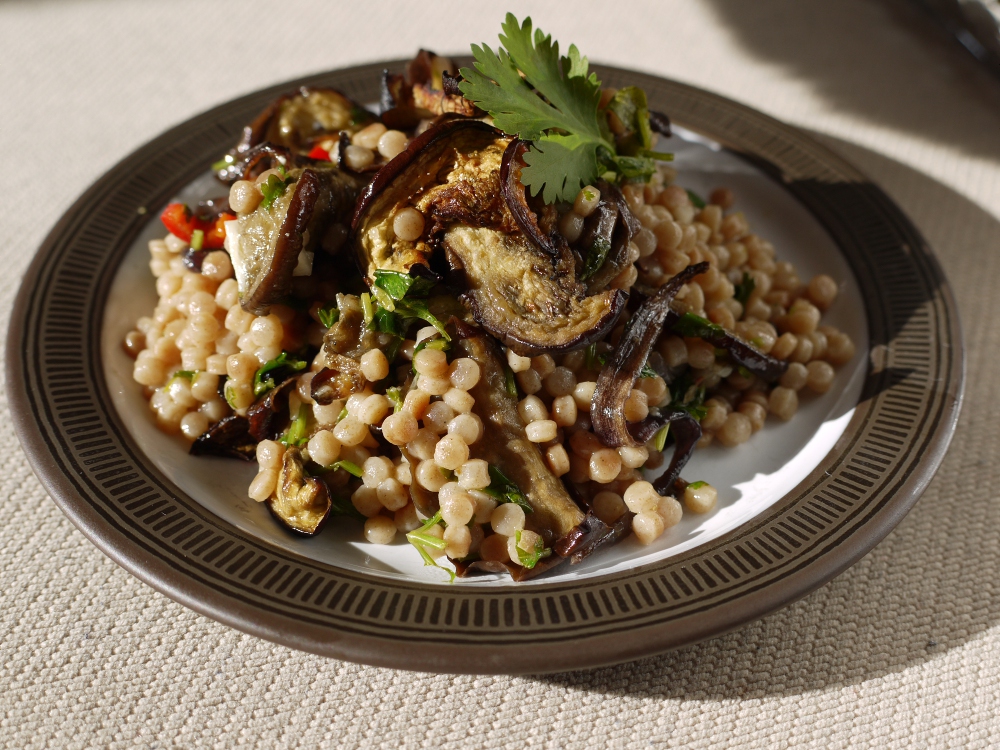
Israeli Couscous with Roasted Aubergine


As soon as IrvingWashington over at Hunger and Sauce posted her Israeli Cous Cous recipe, I knew I had to give it a try. It looked oh so delish with sweetly roasted figs, toasted hazelnuts and crumbly feta. Majorly droolsome.

I must admit that despite my Middle Eastern roots, I hadn't heard of the stuff before. I've used finer North African couscous since my uni days but had never seen this plumper variety. My first hurdle was to find the elusive carbohydrate; my local Sainsburys didn't stock it and the internet wasn't much help ("How much!?"). Luckily, my dearest Papa happened upon some in trusty Waitrose, marketed as 'Giant' Couscous. Dad's rock.


My meal plan fell to pieces when I managed to forget to buy figs. Oops. Still keen to try out my latest ingredient, I raided our fridge and came across an aubergine. I'd picked it up on a rare trip to Asda where they were selling them for 50p - half the price of Sainsburys where I usually shop. Some were little (half the size of the Sainsburys ones) but I rummaged one out which was a good size. I roasted it while I had one or two other bits in the oven so as to be as thrify as possible with my fuel. If you're turning the oven on for cakes or biscuits, why not pop a tray of aubergines or peppers in too? They'll keep well in a container in your fridge for at least a few days or you could freeze them for when you next need them?

Anyway, here's my Israeli cous cous recipe. I hope you like it! I'm still hoping that I remember to pick up those blasted figs when I'm next at the supermarket so that I can try out IrvingWashington's recipe!


Aubergine Israeli Couscous

Serves 2 as a side dish

1 aubergine
1 red onion, peeled
3 tbsp sunflower oil
100g Israeli or ‘Giant’ couscous
½ tsp vegetable stock powder (or around ¼ of a cube)
½ lemon, juiced and zested
2tbsp olive oil
1 tsp ground cumin
1 tsp white wine or cider vinegar
Handful of coriander, chopped
1 tsp chilli, finely chopped
1 clove garlic

- Whip the top off the aubergine, slice in half and cut into 5mm pieces. Do the same with the onion and place in a bowl. Pour 2 tbsp of sunflower oil over and toss until coated.
- Pop on to a baking tray and gently shake from side-to-side to level.
- Put into the oven and roast for 30 minutes at 190C. Remove the aubergine half way through cooking and stir so that it cooks evenly and goes golden on both sides.
- Meanwhile, heat the remaining 1 tbsp of sunflower oil in a pan over a medium heat and add the couscous. Gently brown the couscous for a few minutes so that it darkens slightly.
- While it cooks, measure out 200ml of cold water and add the stock powder and the whole garlic glove. Stir until the stock has dissolved.
- Add the water to the couscous and stir. Turn the heat below the pan to low, cover and bring to a simmer.
- After a minute, remove the garlic clove and then continue to simmer for about 15 minutes or until the water has been absorbed and the couscous is tender. Stir every so often so that it doesn’t clump together. You may need a little more water depending on your couscous.
- Mince the garlic and combine it with the olive oil, lemon juice, zest, chilli, cumin, vinegar and coriander in a large bowl. Add the aubergine and couscous and toss with your hands until everything has an even coating of dressing.
- Serve garnished with coriander leaves. Lovely with poached eggs or harissa chicken.

Thursday, 23 June 2011

Apple & Blackcurrent Crumble Flapjacks

Blackcurrants and redcurrants freshly picked from Thurloxton's fields

Summertime is on it's way and with it comes the the seasonal glut of glorious fruit and vegetables. One thing to make the most of (apart from the last trickle of British asparagus) is soft fruit. The supermarkets are packed with them - British strawberries and raspberries were both on offer when I last went - but the quality can be a little hit and miss as they are difficult to transport. That's the trouble with soft fruit. It's, well, soft.

Luckily for us, we have a great pick your own place nearby called Thurloxton Growers which grows all sorts from rhubarb and gooseberries to broadbeans and asparagus. They have several fields with lots of produce fresh on the vine, bush or plant to pick at your own pace. It's not cheap but the quality is amazing and they tend to have fruit that is otherwise hard to come by - red gooseberries and loganberries to name just two. Have a look for some fields near you here or type 'Pick your own' and then your location into a search engine. Many places, Thurloxton included, sell other local produce such as fresh cream to go with your freshly picked strawberries!

Otherwise, if you're stuck with the supermarket for your fruit, take a minute to take a close look at the fruit that goes into your basket. If the fruit has darker, soft patches or looks bruised, find another punnet. Alternatively, if you want your berries for jam or will be using them the same day, corner a member of staff and ask for a discount. It might sound embarrassing but if you don't ask, you don't get.


I spent a lovely afternoon picking red and black currants in the fields of Thurloxton. I'm very partial to eating the redcurrants raw if they're sweet enough but the blackcurrants proved a little too tart for snacking on. My Mother-in-Love had suggested jam but I wanted to do some baking with them.

What to make with my hoard? I adore flapjacks. They feel like the less sinful option when you fancy something cakey. They have butter and sugar in like a sponge but they contain oats instead of flour. That makes them healthy, right? Anyway, British Bramley apples are still in season and you know, dear reader, how much I like the them. It seemed apt to pair British Bramleys with British blackcurrants together.

I whipped up a batch using the apples as a base for the flapjack to give it extra flavour and also to make them moist and chewy. I left the skins in for added fibre (and because I couldn't be faffed to peel them!) which I can't say I've noticed in the finished flapjacks so for the convenience, I'd just keep them on. Once the flapjack base is done, just press the currants onto the surface, sprinkle with sugar and then top with more crumbly oats for a satisfying crunch before you pop it in the oven. It might sound like a lot of trouble for a flapjack but it's actually really simple and adds a lot to the finished article. I imagine that this would work well with any seasonal fruit that you've got lying about. You could also use frozen soft fruits from your freezer or from the supermarket outside of season.


Apple & Blackcurrant Crumble Flapjacks
Makes 12 pieces

For the flapjack base
3 large Bramley apples
200g oats
35ml honey
75g butter
60g sugar
100g fresh (or frozen) blackcurrants, washed

For the crumble topping
55g oats
15g butter, cubed
55g flaked almonds

 - Preheat the oven to 180C. Line a 20cm by 20cm baking tin with parchment paper.
 - Wash the apples, core them and chop into roughly 1cm cubes.
 - Put into a saucepan over a low heat with 40g of the sugar. Cover and simmer gently for around 10 - 15 minutes or until the apples start to fall apart.
 - Meanwhile, make the crumble topping by rubbing the butter and oats together with your fingers.
 - Stir the apples to form a smoothish paste. Add the butter and honey and bring to a gentle simmer.
 - Add the oats and stir until they're completely coated.
 - Press into the prepared tin, using a spatula or spoon to level.
 - Press the blackcurrants into the top of the flapjack and sprinkle with the remaining sugar.
 - Top with the crumble topping and scatter with flaked almonds.
 - Bake for 30 minutes until the blackcurrants burst and and the almonds and oats are golden.

Tuesday, 21 June 2011

Snapshot: Podding Peas

As I've previously mentioned, healthy snacks are rather difficult to come by. Eleven o'clock comes around on a weekday and my office erupts with the rustling of crisp packets and biscuit wrappers. Temptation is rife but today, I am fine. For today, dear reader, I have peas.

Just like my colleagues' convenience foods, they come in their own hygienic wrapping and can be picked on while I'm typing or draughting away. Unlike my workmates fodder, they are low in salt, sugar, preservatives and other nasties. They have a satisfying snap as I pop open the pod, which keeps me entertained (it's the simple things in life...). And as an added bonus, any waste can be composted - you can't say that about your average bag of crisps or biscuits!

British peas are in season right now and the supermarkets are stocking them. They're not cheap if you're compare them with the dinner staple frozen variety but we eat them in a very different way; on their own, raw and straight from the shell. They'd be lovely cooked and added to various meals but why over-complicate something that is so delicious on its own?

Monday, 20 June 2011

Grilled Courgette & Halloumi Salad


Father's Day. A another celebration (to add to the list along with Mothers Day and Valentines Day) dreamed up by the ingenious card companies to line their pockets after the card-buying frenzy of Christmas. I love my Dad and I hope that he knows how much I appreciate him but I quite like having an excuse to treat him. I suggesting inviting both The Boy's and my parents over for the day along with my siblings (The Boy’s sister lives too far away, sadly).

We may have stuck a finger up at card-giving commercialism but it did mean that we’d be cooking for eight. Blimey. I decided on a simple menu – a shared lunch of salads with homemade bread and a roast for dinner – but was still faced with tons of preparation in order to get to relax on the day. So, after an hour of aerial hoop and lunch with friends, I got down to some serious prepping. I quickly realised that - after my earlier exertions - once I stopped, I wouldn't be able to start again so I got through as many of many tasks with as much vigour as I could muster. I peeled vegetables for the roast, I soaked pulses for a bean salad, I roasted aubergines for a salad and I melted chocolate for a low(ish) fat cheesecake. Phew!

Sunday dawned and my muscles had locked up into a knot of achey lead. The Boy had helped me to prep a salad of seasonal courgettes and haloumi cheese which I thought would go down well with one and all. As he griddled, his brain was whirring - my recipe idea had sparked some foodie inspiration. He added peppers to my base of courgette, cheese, oregano and olives and topped the whole thing off with a sprinkling of sesame seeds. While the grill pan was still hot, I whacked on a lemon and stuck the grilled, caramalised halves on the plate to dress.

As our visitors arrived bearing various divine dishes - my Mum brought a fantastic homemade polenta based gluten free quiche while my Mum-in-Love brought a broad bean and bacon salad. Eight around our little table was, urm, rather friendly to say the least but it was made bearable by the mountains of food. My batch of green olive foccacia went down a storm but it was the courgette salad that was the real star of the show. The courgettes become sweet and soft when grilled which contrasts nicely with the salty bite of the green olives. The weather (predictably unpredictable) wasn't on our side and we didn't fancy barbecuing on our driveway so we used a grill pan but this could be popped on the barbie for a truly smokey flavour.


Grilled Courgette & Haloumi Salad
Serves 6 - 8 as a side dish

4 medium courgettes
2 peppers
250g halloumi cheese, drained and sliced
100g green olives, sliced
1 lemon
25g sesame seeds
handful of oregano leaves
sunflower oil

 - Put a griddle pan on a high heat to warm up until smoking. Alternatively, prepare your barbeque.
 - Wash the courgettes and cut them lengthways. Try to get them around 5mm thick but don't worry too much if you can't as they're not the easiest of things to cut! Deseed and slice the peppers and pop everything in a bowl with the halloumi cheese.
 - Drizzle the courgettes and pepper with a little oil and mix so that they are well covered. Carefully brush the griddle with a little oil on a heatproof brush or a kitchen towel.
 - Grill the courgette and pepper for a few minutes on each side until they are slightly softened and have charred lines. Remove to a serving dish.
 - Next, grill the halloumi for about 4 minutes, turning each slice so that it crisps up slightly and becomes charred. Add to the serving dish with the other vegetables.
 -  Turn off the heat under the pan and immediately put two lemon halves, cut side down, on to the grill. Leave for a few minutes until they are caramalised and browned.
 - Meanwhile, add the olives and oregano leaves to the dish and toss the salad. Top with sesame seeds and oregano sprigs. Serve with the grilled lemon halves to squeeze over.

Saturday, 18 June 2011

Review: Zazu's Kitchen


After an hour of strenuous aerial exercise (my latest passion is aerial hoop), me and two friends found ourselves wandering the Stokes Croft area of Bristol in search of sustenance. You may have heard of this creative and dynamic area in the news of late but don't let recent events put you off; this is a lovely part of Bristol which is well worth exploring.

After some dithering, we decided on Zazu's Kitchen. From the outside, it seems like a small establishment but inside, it's somewhat tardis-like. Our first impression was confusion; they'd been closed in the morning for a private event (the chef later told us that they'd cooked full English breakfasts for thirty people - rather him than me!) and the staff were trying to get the place in order. We were welcomed in to take a seat while we waited for them to ready themselves and soon had hot drinks in front of us. Zazu's is the kind of place that serves tea in a pot and proper frothy, chocolatey cappuccinos. Points there.

We were further perplexed when trying to order food. Apparently, they weren't ready to take orders. No, we couldn't place our order in advance for when the kitchen re-opened. Hrmph. We placated our hunger with more drinks. Incidentally, their hot chocolate is ace and they have an impressive selection of Fentiman's traditional soft drinks. While we waited, I had a little look around. There's a small, central, open kitchen which acts as the heart of the place as well as a divide between the front of the café and the more secluded back area. There was fresh pasta strung up to dry on poles all around the place - a nice touch showing that they make their own produce in house.

Eventually, the time came and food was being served. The menu looked fantastic; full of seasonal and local produce mixed with homemade basics. But before we could get up to place an order, a queue formed that trailed out of the door. Poor timing on our part, I suppose but unfortunate nevertheless. After (what felt like) an eternity of queuing, we settled ourselves for a 25 minute wait for our food. This was well spent people watching. Stokes Croft attracts a diverse array of characters but Zazu's seemed to be filled with painfully cool twenty-somethings - boys with silly, indie hair and girls with blank expressions and 'granny' shoes.

Our food arrived and it was certainly worth the wait. We enjoyed a confit of duck with crispy polenta and a gooseberry compote, a risotto of asparagus and preserved lemon and a piece of pan-fried cod on a bed of puy lentils and roasted peppers. The duck was a little dry but it worked well with the acidity of the gooseberry compot, which cut through fattyness of the meat. The polenta had a satisfyingly hard crust but a lovely soft interior - much nicer than my bland attempts at home. The risotto was deliciously fresh in flavour but still thick and creamy. The rice was perfectly cooked and it was interspersed with delicate slices of preserved lemon peel, which lifted the whole dish. The cod was perfectly cooked and the lentils were surprisingly meaty. All in all, a great meal for the food alone.

Zazu's Kitchen is great for a lazy breakfast or lunch when you're not in a hurry. If you have the time to sit back and enjoy watching the world go by (or by writing intense thoughts/ideas for meaningful song lyrics in your journal like many of the clientelle) while nibbling on delicious, seasonal food then this is the place to do it. They serve various teas, coffee any which way and wine, depending on your mood. Food is reasonably priced for the quality but you don't get a huge amount (not a problem for me but this might have left The Boy wanting).

Zazu's Kitchen can be found at 45 Jamaica Street, Bristol, BS2 8JP. Lunch dishes from around £7 - £12.

Friday, 17 June 2011

One Pot Chicken

“Have you taken photo’s of this?” sighed The Boy. This can be roughly translated from Boy-talk as “Am I allowed to eat this yet?”. Poor guy; I have this dreadful habit of taking photos of our food (most of which end up on here!). Worse still, I’ve been reading up and attempting to develop the quality of my photographs which means that I’ll often be heard barking “You’re in my light!”. Not the most gentile of pre-dinner conversation.

My terrible table habits aside, life hasn’t been easy for The Boy in recent weeks so I’d decided to treat him to a relaxing evening. Naturally, this included a hearty, home cooked meal to make his tummy happy (what with the way to a man's heart being through his stomach and all that). I’d wanted something that would be bursting full of flavour but wouldn’t require too much nursing over the stove. Sure, there’s a time and place for complicated recipes but after work, I’d rather keep things simple.

Rewind by a couple of days to when Angela Harnett’s recipe for Hunter’s Pot Roast Chicken caught my eye on the Guardian’s website. Straightforward, undemanding and more of a starting point than a recipe as I could see the potential to swap-out ingredients depending on what was available.

I gave myself a head-start by prepping the marinade and slathering the chicken that morning before leaving it to infuse in the fridge while I was out at work. Five minutes prep was all it took. On my return, I took the chicken out so that it could come up to room temperature before it cooked. I decided to go with seasonal greens – kale and spring green cabbage – and the last of the British asparagus that I could find. Keep your eyes peeled in the supermarkets as the Peruvian stuff is gradually coming back to the shelves in place of the lovely British spears that we’ve been spoilt with recently.

I served it up with The Boy’s favourite lager and some juicy jersey royals but it’s a great adaptable recipe. Use whatever is in season and is in your larder. Very little washing up too!

“Yes, my darling. I’ve taken all the photos I’ll need. Tuck in!”


One Pot Chicken
Serves 2

For the marinade
½ chilli, sliced
2 cloves of garlic
2cm fresh ginger, chopped
Juice and zest of ½ lemon

4 chicken thighs and/or drumsticks
170ml white wine, vermouth or stock
½ onion, sliced
2 large leaves of spring greens, washed and finely sliced
Large handful of curly kale, washed
1 bunch of asparagus
Sunflower oil

- Pound the ingredients for the marinade with a pestle and mortar or whizz up in a food processor. If you don’t have either, finely chop the chilli, garlic, ginger and lemon zest together on a chopping board and then mash together with the lemon juice.
- Slash the chicken a few times with a knife and then rub with the marinade. Leave on one side while the flavours infuse for as long as possible.
- Steam the greens and kale by rinsing them and putting them into a microwaveable dish. Put a lid or plate over (or cover with cling film) and microwave for 5 minutes or so.
- Heat a little sunflower oil in a saucepan or casserole dish. Brown the chicken skin side down and then turn over.
- Drain away any fat and then deglaze the pan with wine/vermouth/stock. Do this by pouring in the liquid and gently stirring, pushing any the browned bits that have cooked on to the bottom of the pan.
- Sprinkle the onion over the chicken and stir. Simmer gently, turning the chicken to ensure that it cooks evenly, for 15 – 20 minutes.
- When the juices run clear, remove the chicken from the pan and add the steamed greens and asparagus with any cooking juices from steaming the veg. Put the lid on the pan and cook for a few minutes until the asparagus is as you like it. We like it al dente (and The Boy will happily eat it raw) so this didn’t take long.
- Return the chicken to the pan. Serve with jersey royals, par-boiled and then fried in the chicken fat, or crusty bread.
Related Posts Plugin for WordPress, Blogger...